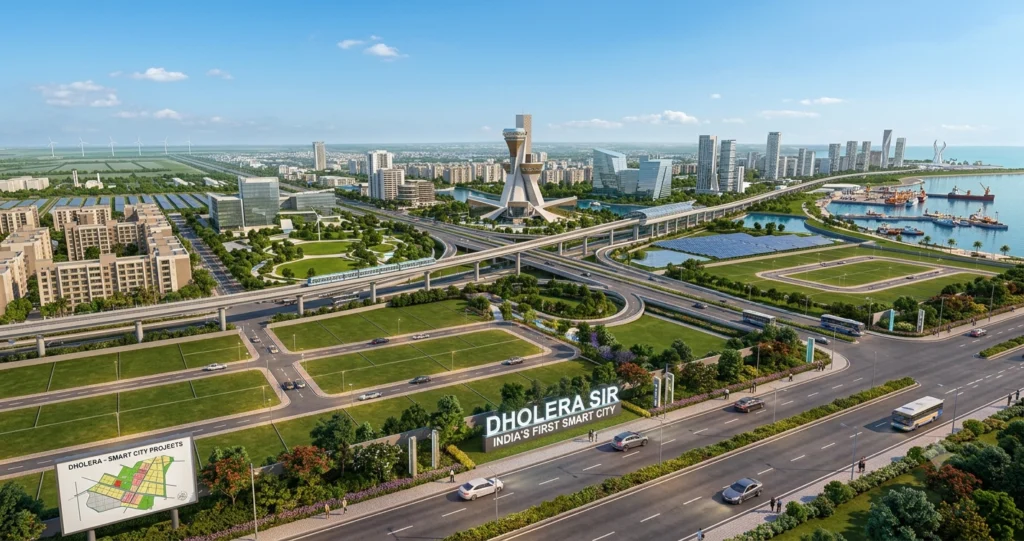
One question has become increasingly common among investors over the last few months:
“Why has there been no major announcement about new infrastructure development inside Dholera SIR after the completion of the Activation Area?”
Some investors have started wondering:
- Has the Government stopped developing Dholera?
- Is the project moving slower than expected?
- Which Town Planning (TP) Scheme will be developed next?
- Is this still the right time to invest?
These are genuine questions, and every investor deserves a balanced answer based on facts rather than rumors. Having closely followed Dholera for more than 12 years, author CA Ramesh Rajaram Gurav addresses these concerns in the context of how large industrial cities evolve.
✍️ Author Perspective: Written by CA Ramesh Rajaram Gurav, Chartered Accountant with over 25 years of professional experience and 12+ years tracking Dholera’s development framework.
⚡ Has Development Stopped?
In short: No. What has changed is the government’s priority, not its commitment. The focus has shifted from expanding internal roads to making existing infrastructure productive by creating an economic ecosystem.
Building an Economic Ecosystem vs. Unused Infrastructure
Building roads alone does not create a city. A successful industrial hub requires industries, employment, transportation, housing, education, healthcare, hotels, logistics, and commercial activity.
Instead of announcing another large internal development phase immediately, the Government is concentrating on projects that generate long-term economic activity around Dholera:
- Dholera International Airport & Aviation Ecosystem Planning (MROs, Pilot Training)
- Ahmedabad–Dholera Expressway
- Tata Semiconductor Manufacturing Facility & Semiconductor SEZ
- ReNew Solar Manufacturing Facility
- Ahmedabad–Dholera Semi High-Speed Rail Project & Freight Rail Connectivity
- Social infrastructure and housing to support future employees
Why Isn’t the Next TP Scheme Being Developed Immediately?
Imagine constructing roads, drainage, utilities, and public infrastructure across hundreds of additional square kilometers before industries occupy the first developed area. Such an approach would require enormous public expenditure while much of the infrastructure remained underutilized.
Phase 1
Build world-class foundation (Activation Area).
Phase 2
Attract anchor industries (Tata, ReNew).
Phase 3
Generate employment & economic activity.
Phase 4
Expand infrastructure based on actual demand.
Which Area Will Be Developed Next?
The honest answer: No official announcement has yet been made regarding the sequence or timeline for the next large-scale development phase inside Dholera SIR.
Until such an official announcement is made, any claim about the “next TP Scheme” should be treated as speculation. Future expansion will depend on:
| Expansion Factor | Why It Matters |
|---|---|
| Industrial Occupancy | Determines real usage of the Activation Area. |
| Airport Operationality | Triggers regional commercial & logistics demand. |
| Employment & Population | Drives demand for housing, commercial, and social infrastructure. |
| Budget Allocations | Aligns government capital expenditure with real demand. |
💡 The Golden Growth Belts Strategy
While internal expansion waits for industrial demand, infrastructure around the airport is progressing rapidly. Investors should evaluate two distinct zones:
• Inside Dholera SIR: The corridor surrounding the Activation Area.
• Outside Dholera SIR: The Airport Growth Corridor (Kamatalav, Navagam, Buranpur, Pipli).
Conclusion:
The absence of announcements about a new large-scale internal development phase should not be interpreted as the end of Dholera’s growth story. Instead, it reflects a transition from building infrastructure to creating an industrial and economic ecosystem around that infrastructure.Cities of this scale evolve through carefully planned phases. As the airport becomes operational, semiconductor manufacturing begins production, and transport links finish, demand for future expansion will become clear. Follow facts, infrastructure, and policy—not rumors.