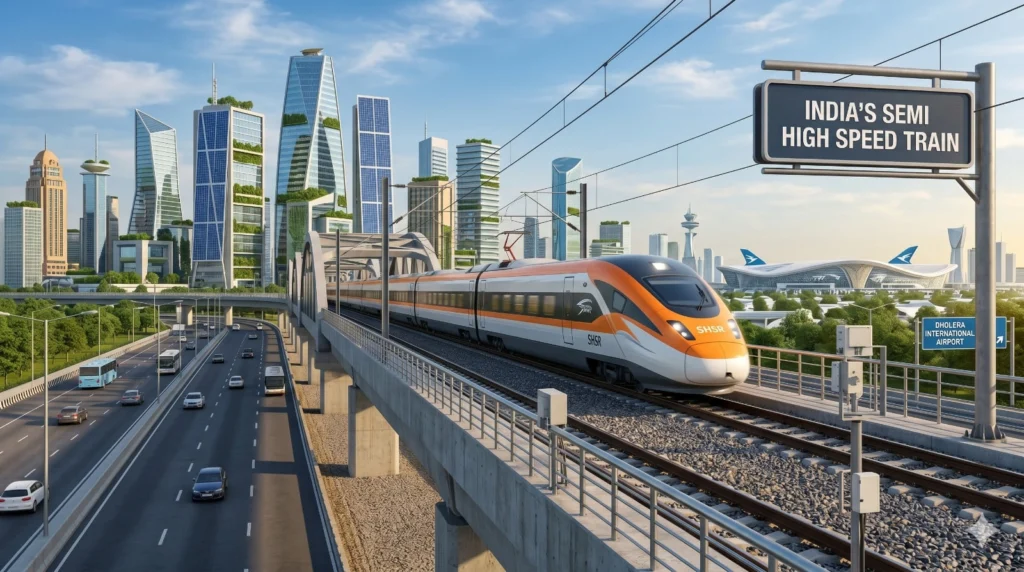
One of the most common questions people ask about Dholera Smart City is:
“Is the Ahmedabad–Dholera Semi High-Speed Rail Project a Metro or an Indian Railways train?”
The confusion is understandable because both Metro Rail and Indian Railways operate on tracks and provide public transportation. However, they are designed for different purposes. This article explains the difference and clarifies what the Ahmedabad–Dholera Semi High-Speed Rail Project really is.
⚡ The Short Answer
The Ahmedabad–Dholera Semi High-Speed Rail Project is NOT a Metro. It is a new Indian Railways double-line Broad Gauge railway corridor designed for semi high-speed train operations.
Why Do People Think It Is a Metro?
There are several reasons for the confusion:
- The project promises fast travel between Ahmedabad and Dholera.
- It is being built on a completely new alignment.
- Many people naturally associate fast trains with metro systems.
- Ahmedabad already has an operational Metro network, so people assume the Dholera project might be an extension.
However, this is not the case.
🚇 Ahmedabad Metro
Purpose: Urban public transport within cities.
- Multiple stations within the city
- Frequent, short-distance services
- Designed for daily urban commuting
- Moderate operating speeds
🚆 Semi High-Speed Rail
Purpose: Fast intercity transport across regions.
- Connects major regional destinations
- Limited, strategic stations
- Broad Gauge Indian Railways corridor
- Design speeds up to 220 km/h
Metro vs Indian Railways: Side-by-Side Comparison
| Feature | Metro Rail | Ahmedabad–Dholera Rail |
|---|---|---|
| Purpose | Urban transport | Intercity transport |
| Coverage | Within cities | Between Ahmedabad and Dholera |
| Stations | Many | Limited |
| Distance | Short | Long (134 km) |
| Operator | Metro Rail Corporation | Indian Railways |
| Railway Type | Metro Standard Gauge | Broad Gauge Railway |
| Speed | Lower / Moderate | Design speed up to 220 km/h |
Will It Connect With Existing Indian Railways?
Yes. Although this is a newly constructed railway corridor, it is an integral part of the national Indian Railways network.
This means passengers travelling from major Indian cities such as:
- Mumbai
- Delhi
- Jaipur
- Vadodara
- Surat
- Rajkot
may be able to connect seamlessly through Ahmedabad to reach Dholera, subject to final operational plans and interchange arrangements.
Is It Similar to Vande Bharat?
A better comparison is with modern semi high-speed intercity services like Vande Bharat. Focus areas include:
- Higher operating speeds
- Superior passenger comfort
- Significantly faster travel times
- Modern, indigenous railway technology
Why Is This Railway Important?
The corridor is expected to support several strategic economic hubs:
- Dholera Smart City (SIR)
- Tata Semiconductor Manufacturing Facility
- Dholera International Airport
- National Maritime Heritage Complex (Lothal)
It will dramatically improve regional mobility for industrial employees, business travellers, tourists, investors, students, and local residents. Travel time between Ahmedabad and Dholera will drop to approximately 48 minutes, making it significantly faster than road transport.
Frequently Asked Questions
Is Dholera getting a Metro?
No. The currently approved project is a semi high-speed Indian Railways corridor, not a Metro system.
Will Metro trains run to Dholera?
There is no approved project at present extending the Ahmedabad Metro network to Dholera. Future transport plans could evolve, but no extension has been officially approved.
Is this part of Indian Railways?
Yes. It is planned as a double-line Broad Gauge railway corridor under Indian Railways.
Will it connect to Dholera Airport?
Yes. The corridor is planned to serve the upcoming Dholera International Airport as part of the region’s integrated transport network.
Conclusion:
The Ahmedabad–Dholera Semi High-Speed Rail Project is not a Metro extension. It is a modern Indian Railways intercity corridor designed to provide fast, efficient connectivity between Ahmedabad, Dholera Smart City, Dholera International Airport, and Lothal.Understanding this distinction is important because the project plays a far broader role than an urban metro system. It is engineered to power industrial growth, regional mobility, tourism, and long-term economic development across the entire corridor.