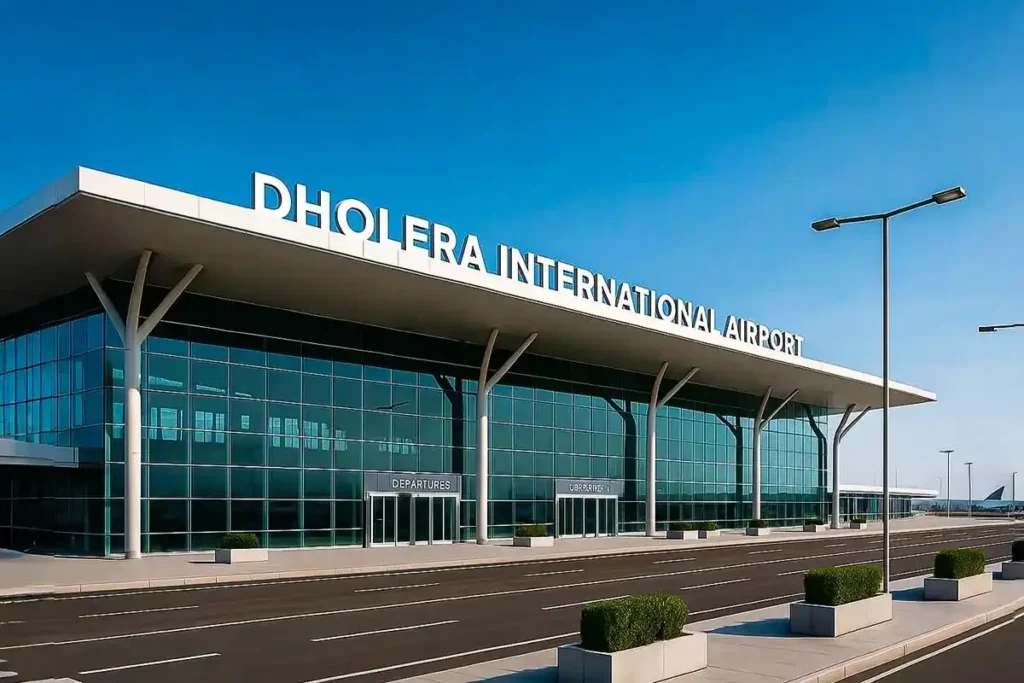
Dholera International Airport is one of the most important infrastructure projects supporting the development of Dholera Special Investment Region (SIR). Designed to serve India’s first Greenfield Smart Industrial City, the airport will provide direct air connectivity for passengers, cargo, high-value manufacturing, and global businesses.
With the Tata Semiconductor project, Ahmedabad–Dholera Expressway, and world-class industrial infrastructure progressing simultaneously, the airport is expected to become a major catalyst for economic growth across the region.
✈️ Latest Construction Status
The Dholera International Greenfield Airport has entered its final phase of construction. According to the latest review by the Ministry of Civil Aviation:
- Overall Completion: Approximately 80% finished
- 100% Completed Assets: Runway, taxiway, Air Traffic Control (ATC) tower, and airside structures
- Passenger Terminal: Approximately 75% complete
- Target Operations: September–October 2026 (subject to DGCA approvals)
A Project of National Importance
During a recent site visit, Union Civil Aviation Minister Shri Ram Mohan Naidu described Dholera International Airport as a project of national importance.
He highlighted that this is the first airport in India planned alongside a Greenfield Smart City, a semiconductor manufacturing cluster, and an advanced industrial ecosystem, making it unique among India’s infrastructure projects.
Passenger and Cargo Capacity
The airport has been engineered to serve both passenger travel and high-value industrial logistics:
🧳 Passenger Terminal
- Spans approximately 25,000 sq. m.
- Initial handling capacity of nearly 2 million passengers annually
- Designed for seamless future scaling
📦 Dedicated Cargo Hub
Facility size: 2,500 sq. m.
Tailored to support:
- Semiconductor manufacturing
- Electronics & high-value exports
- Precision engineering equipment
Multi-Modal Connectivity
The airport will not function as a standalone aviation facility. It is tightly integrated into Dholera’s broader infrastructure network, including:
- Ahmedabad–Dholera Expressway (featuring dedicated airport access ramps)
- Semi High-Speed Rail Corridor
- Dholera Smart Industrial City & Activation Zone
- Tata Semiconductor Manufacturing Facility
- Future logistics parks and industrial clusters
🔌 Supporting India’s Semiconductor Mission
One of the primary beneficiaries of the airport will be India’s emerging semiconductor industry. Semiconductor manufacturing depends on ultra-fast international connectivity, time-sensitive cargo movement, import of sophisticated capital equipment, and rapid export of high-value chips. The airport provides direct logistics support to Tata Semiconductor Manufacturing Private Limited and the broader supply chain ecosystem.
Towards an Aerotropolis
The Ministry of Civil Aviation has described Dholera as an “Aerotropolis”—an airport-centric urban and industrial ecosystem where aviation infrastructure directly drives manufacturing, logistics, business parks, commercial development, and employment.
Future development plans around the airport include:
- Maintenance, Repair, and Overhaul (MRO) facilities
- Industrial logistics and warehousing hubs
- High-speed rail integrated terminals
- Commercial & hospitality centers
Why the Airport Matters for Dholera Investors
Modern global industries prioritize fast international connectivity, efficient cargo movement, plug-and-play land, and reliable infrastructure before choosing plant locations.
The airport complements Dholera’s core advantages:
- Anchor projects like the Tata Semiconductor plant
- Plug-and-play industrial infrastructure
- Rapid transport links via the Expressway
- Strong policy backing from both State and Central governments
A major international airport historically transforms regional economics by driving export industries, attracting FDI, creating direct and indirect jobs, and accelerating long-term commercial and real estate development.
Frequently Asked Questions
When is Dholera International Airport expected to open?
The Government is targeting September–October 2026 for commercial operations, subject to regulatory clearances from the DGCA.
How much construction has been completed?
Approximately 80% of the overall airport project is finished, with critical airside infrastructure (runway, ATC, taxiway) at 100%.
What will be the passenger capacity?
The airport is designed to handle approximately 2 million passengers annually in its initial phase.
Why is the airport strategically important?
It serves as the global air gateway to Dholera SIR and is directly integrated with the semiconductor ecosystem, expressway, and regional rail corridors.
Conclusion:
Dholera International Airport is much more than a transportation project. It is a critical piece of infrastructure supporting India’s vision of building a globally competitive manufacturing ecosystem.Together with the Tata Semiconductor plant, Ahmedabad–Dholera Expressway, and Dholera Smart City, the airport strengthens the region’s ability to attract investment, improve connectivity, and support long-term industrial growth. For investors and businesses tracking Dholera’s progress, the airport’s rapid construction represents a major milestone in the city’s evolution.